- January 29 2026
- Food safety
Food Safety Regulations: How to Find Your Way?
At a time when food safety is at the heart of concerns for consumers, businesses, and public authorities alike, understanding the regulations governing this sector has become essential. Food standards are not merely legal obligations; they are powerful drivers of trust, sustainability, and competitiveness for stakeholders in the agri-food industry.
This blog article provides a structured analysis of the key challenges related to food safety, the main regulations currently in force, and best practices for implementing them effectively within organizations. The goal is to offer a clear and practical perspective, enabling professionals to turn regulatory constraints into opportunities for growth and differentiation.
Summary
1. What are the main challenges addressed by health and safety standards?
2. What regulations are in place to ensure the safety of our food?
3. How can these regulations be implemented within a company?
Conclusion: Towards safer and more responsible food?
1. What are the main challenges addressed by health and safety standards?
Tools to secure the food supply chain
Food safety is a critical issue that helps maintain consumer trust and preserve a strong brand image. In the event of food scandals, the consequences can be significant, affecting both the economy and the environment.
For this reason, strict and essential food safety regulations have been established. These regulations evolve every year and aim to ensure full traceability, from production to distribution. Indeed, contamination can occur at any stage of the food supply chain, potentially altering products intended for sale. Each stakeholder is therefore responsible for the quality of the food they place on the market, as consumer health is at stake.
With the ultimate goal of ensuring reliable food hygiene, official inspections are carried out within companies. These may take the form of regular inspections as well as unannounced checks. The results of these assessments are published on platforms accessible to everyone, such as the Alim’Confiance website.
Preventing risks and strengthening trust
Health and safety checks are essential to ensure clean environments that support the proper development of food products. Implementing a food safety management system serves both strategic and operational objectives. By ensuring compliance with legal requirements, organizations not only avoid penalties but also strengthen their credibility with authorities and consumers.
This system builds customer trust by guaranteeing the safety of products and services in line with current standards. By assessing customer expectations and reducing complaints, companies can improve their overall performance. Finally, such a system is a powerful lever for enhancing the organization’s brand image and supports the continuous improvement of established practices. Monitoring food hygiene also facilitates the management of incidents involving suppliers as well as other stakeholders.
A targeted response to foodborne pathogens
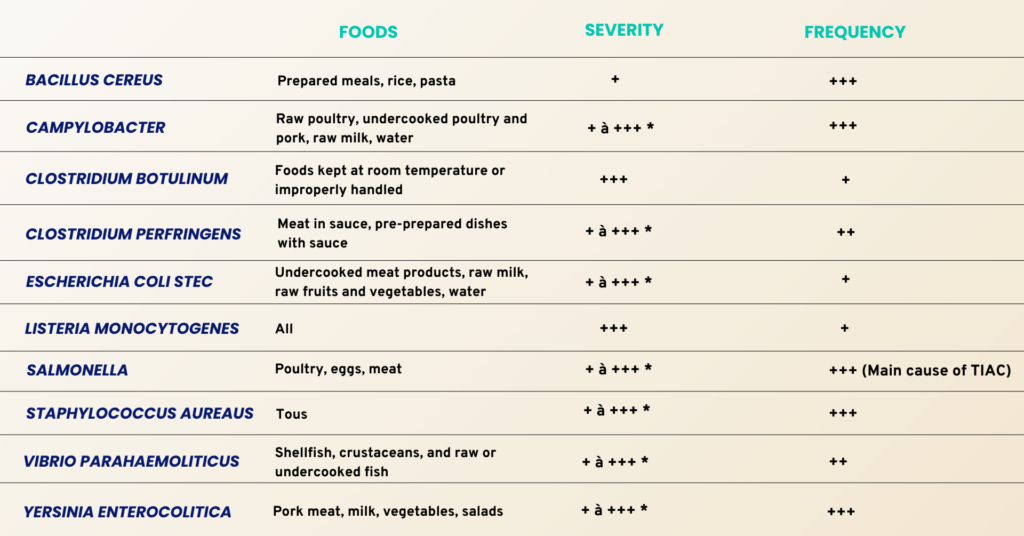
* For at‑risk populations
At the top of the list of bacterial pathogens, Salmonella is responsible for the highest number of foodborne outbreaks (collective food poisoning incidents). Escherichia coli STEC (found in undercooked meat products) and Bacillus cereus (commonly associated with rice‑ or pasta‑based dishes) are also among the most frequent or most serious foodborne pathogens.
2. What regulations are in place to ensure the safety of our food?
Worldwide Coordination
To ensure food safety on a global scale, specific regulations have been established to promote consistency across countries.
Created in 1963 by the Food and Agriculture Organization of the United Nations (FAO) and the World Health Organization (WHO), the Codex Alimentarius is a collection of more than 300 standards, guidelines, and codes of practice. This “food code” serves as a global reference for food safety. It guides national legislation and facilitates international trade by harmonizing quality and control requirements. The Codex applies to all stakeholders across the food supply chain, regardless of sector: dairy products, meat, cereals, oils, fruits, and more.
Following the same approach, the ISO 22000 standard provides a food safety management system applicable to any organization involved in the food supply chain. It incorporates the principles of the HACCP (Hazard Analysis and Critical Control Points) plan as well as good hygiene practices, enabling companies to obtain internationally recognized certification that demonstrates reliability and compliance with global standards.
The European Regulatory Framework
As at the global level, European regulations are numerous and aim to protect public health. These legislative frameworks are robust and harmonized to ensure compliance throughout the entire agri‑food chain, from farm to fork.
Since 2006, the Hygiene Package has strengthened requirements related to traceability, hygiene, and official controls. It forms the foundation of food legislation within the European Union through regulations governing the hygiene of food intended for both human and animal consumption. These texts are regularly updated to reflect technological advancements and emerging health challenges. This legal framework is further complemented by specific regulations covering microbiological criteria, food of animal origin, and animal feed.
In addition, the European Commission has committed to developing a future‑oriented food safety budget and a coherent, responsible nutrition policy, in line with the recommendations of the EFSA (European Food Safety Authority). Thanks to this approach, Member States share a common reference framework, which promotes innovation and transparency in individual practices. The EFSA is the European equivalent of ANSES (the French Agency for Food, Environmental and Occupational Health & Safety).
With the continued objective of protecting public health, safety criteria have been harmonized, notably through the implementation of Regulation (EC) No 2073/2005. This regulation defines food safety and hygiene criteria by establishing rules for sampling and analysis methods and by strengthening sanitary quality through increased controls at different stages of production. It is particularly precise, as it specifies the microbiological thresholds that must be met.
What are the benefits of these laws at the national level?
In France, regulations are based on European legislation—particularly the Hygiene Package—as well as on provisions established at the national level. Various ministerial decrees specify the rules applicable to products of animal origin, retail businesses, and transport activities. These texts incorporate the margins for adaptation provided for under the European framework. Other legal codes also apply, such as the Rural and Maritime Fishing Code, which strengthens the existing framework by imposing mandatory food hygiene training requirements. Professionals in the sector must comply with several equally important obligations: implementation of HACCP principles, traceability, sanitary declaration or approval, and submission to regular inspections by the competent authorities. These frameworks, defined at the European level, aim to ensure effective control of health risks from production through to distribution.
3. How can these regulations be implemented within a company?
Resources and organizations to support businesses
To help companies implement these regulations, professional trade associations are available. They support businesses in developing food safety management plans, such as HACCP plans. Each association is generally created according to the type of food product, for example IFIP for the pork sector or ATLA for dairy processing.
Food business operators are also encouraged to use Guides to Good Hygiene Practices (GHP). These guides, written by industry professionals and approved by public authorities, are designed to help manufacturers control food safety risks and comply with regulatory requirements. They define testing frequencies as well as the actions to be implemented. However, each company remains responsible for adapting the GHP guide to its specific hazards and production processes.
Organizations such as the CTCPA (Technical Center for the Preservation of Agricultural Products) also provide valuable support. More broadly, they contribute to the implementation of quality management systems within companies.
The HACCP plan: an essential national tool for risk control
Le plan HACCP est une méthode reconnue mondialement pour garantir la sécurité des aliments, et ce tout au long de la chaîne de production. Son approche préventive consiste à identifier, évaluer et maîtriser les dangers chimiques, biologiques et physiques. Les dangers concernent à la fois la sécurité alimentaire, l’hygiène alimentaire et l’hygiène des procédés qui sont susceptibles d’affecter les denrées alimentaires. Le plan HACCP permet de définir les points critiques de contrôle, de mettre en place des procédures de surveillance et des actions correctives en cas de nécessité. Les entreprises doivent se conformer aux exigences règlementaires via la mise en place de ce plan afin de garantir une production sûre et des produits sains pour les consommateurs.
The seven principles of the HACCP plan are hazard analysis, identification of critical control points (CCPs), establishment of critical limits for CCPs, implementation of a monitoring system for these points, development of corrective actions, verification of the effectiveness of the HACCP system, and establishment of a documentation and record‑keeping system.
Applications supporting small businesses and artisans
- Decree of 20 May 2009: clarification of hygiene conditions and adaptation of European regulation requirements to make them more operational within the French context
- Decree of 7 November 2012: simplification measures for small structures and application of Regulation (EC) No 852/2004
Conclusion: Towards safer and more responsible food?
1- Avant-Garde Conseil. (s.d.). 5 pathogènes alimentaires à connaître. https://avantgardeconseil.fr/restauration-artisanat-service/pathogenes-v1/
2- European Commission. (2024, 22 avril). Guidance platform – Food hygiene. https://food.ec.europa.eu/food-safety/biological-safety/food-hygiene/guidance-platform_en
3- European Union. (s.d.). Sécurité alimentaire – Action de l’UE. https://european-union.europa.eu/priorities-and-actions/actions-topic/food-safety_fr
4- FAO & OMS. (s.d.). Codex Alimentarius FAO‑WHO. https://www.fao.org/fao-who-codexalimentarius/fr/
5- FAO & OMS. (s.d.). Principes généraux d’hygiène alimentaire (CXC 1‑1969) (CA1176FR). https://www.fao.org/fileadmin/user_upload/codexalimentarius/images/Publications/CA1176FR.pdf
6- Gouvernement français. (2009, 20 mai). Arrêté du 20 mai 2009 relatif aux dérogations à certaines règles sanitaires applicables aux produits d’origine animale et aux denrées alimentaires en contenant présentant des caractéristiques traditionnelles. Légifrance. https://www.legifrance.gouv.fr/loda/id/JORFTEXT000020719447
7- Gouvernement français. (2012, 7 novembre). Arrêté du 7 novembre 2012 relatif aux règles sanitaires applicables aux produits laitiers présentant des caractéristiques traditionnelles. Légifrance. https://www.legifrance.gouv.fr/loda/id/JORFTEXT000026601296
8- ISO. (s.d.). ISO 22000 — Management de la sécurité des denrées alimentaires. https://www.iso.org/fr/iso-22000-food-safety-management.html
9- Ministère de l’Agriculture et de la Souveraineté alimentaire. (s.d.-a). Guides de Bonnes Pratiques d’Hygiène (GBPH). https://agriculture.gouv.fr/guides-de-bonnes-pratiques-dhygiene-gbph
10- Ministère de l’Agriculture et de la Souveraineté alimentaire. (s.d.-b). La réglementation sur l’hygiène des aliments. https://agriculture.gouv.fr/la-reglementation-sur-lhygiene-des-aliments
11- Ministère de l’Agriculture et de la Souveraineté alimentaire. (2018). Instruction technique DGAL/SDSSA/2018‑924 (info.agriculture.gouv.fr/gedei/site/bo‑agri/instruction‑2018‑924). https://info.agriculture.gouv.fr/gedei/site/bo-agri/instruction-2018-924
12- Norme-HACCP. (s.d.). La protection du consommateur : enjeux des denrées alimentaires. https://www.norme-haccp.com/la-protection-du-consommateur-vis-a-vis-des-denrees-alimentaires-un-enjeu-collectif/
13- World Innovation. (s.d.). Cadre complet des normes de l’industrie alimentaire. https://innovation.world/fr/normes-de-lindustrie-alimentaire/